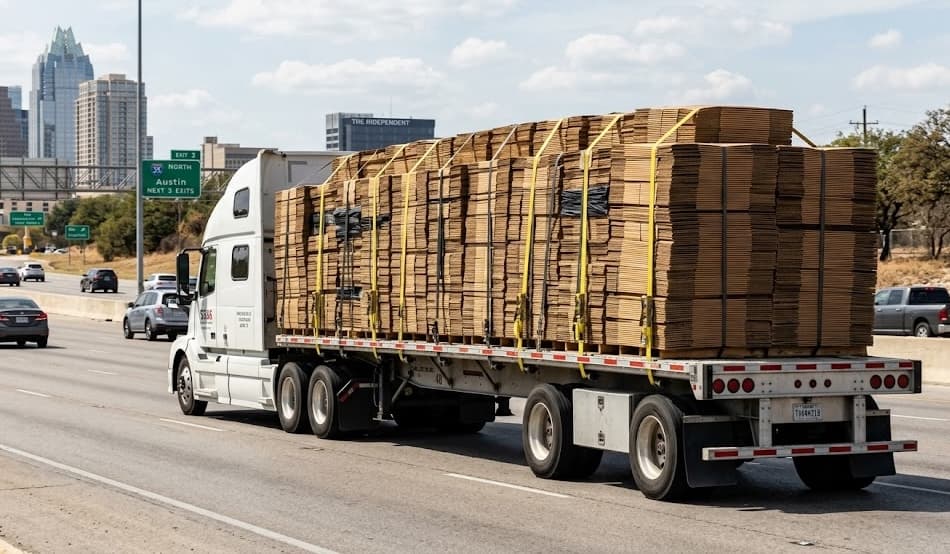
Our lanes.
Colorado, Wyoming, New Mexico, Utah, Kansas, Nebraska, Oklahoma, Arizona, South Dakota, Montana, Idaho. We run weekly milk runs on the Front Range and monthly long-haul routes to the Pacific and the Plains.
Our equipment.
- Dry van trailers, 53 ft, lift-gate optional.
- Flatbeds for oversized or over-height loads.
- Step decks for extra-tall gaylord stacks.
- Small straight trucks for in-city routes.
- Partnered LTL network for sub-pallet shipments.
Who hires us.
- Box customers who want freight bundled into their invoice instead of waiting for a broker to re-route them.
- Companies that need empty corrugated moved across state lines without their main carrier charging them full deadhead rates.
- Sustainability-minded shippers who want a carrier that runs loaded in both directions.
Why we don’t ship air.
Most reverse-logistics lanes are ugly because trucks go out full and come back empty. Our model pairs inbound pickups with outbound deliveries on the same route, so the same trailer is loaded both ways. That’s half the cost and half the CO₂.
Lane pricing benchmarks.
| Lane | 1 pallet | Half trailer | Full trailer (~30 pallets) |
|---|---|---|---|
| Denver metro | $25–$45 | $120–$180 | $240–$340 |
| Front Range north (Boulder/Fort Collins) | $45–$80 | $200–$320 | $380–$520 |
| Front Range south (Springs/Pueblo) | $50–$90 | $220–$340 | $420–$580 |
| Cheyenne, WY | $60–$100 | $280–$420 | $520–$700 |
| Albuquerque / Santa Fe | $120–$180 | $520–$680 | $1,000–$1,300 |
| Salt Lake City | $140–$200 | $580–$760 | $1,100–$1,500 |
| Kansas City | $120–$180 | $520–$680 | $1,000–$1,400 |
Service modes we offer.
- Dedicated dry van. 53-foot trailer, lift gate optional, single customer per trip. Best for full-trailer loads.
- Milk run shared LTL. Routed onto our weekly Front Range loops. Best for 1–10 pallet shipments.
- Flatbed. For oversized or over-height loads that won’t fit in a dry van.
- Step deck. Extra-tall loads, occasionally used for stacked gaylord shipments.
- Straight truck. 26-footers for in-city routes where a 53-foot trailer is impractical.
- Partner LTL. For sub-pallet shipments and lanes outside our routine network.
What loaded-both-ways actually means.
Most freight networks measure performance with a metric called the loaded-mile ratio. It’s the percentage of total trailer miles that were carrying freight. Industry average for reverse logistics is around 60%. Our last reported number was 91%. The 31-point difference is the entire reason we can offer competitive freight on empty corrugated, which is otherwise a very ugly category to ship. Every pickup is paired with a delivery and every delivery is paired with a pickup — and on the rare occasions we can’t pair them, we delay the trip until we can.
Insurance and liability.
We carry standard cargo and liability insurance for our equipment and for partner LTL carriers. Certificates of insurance are available on request and we can name additional insureds if your procurement process requires it. We do not insure against consequential damages or against losses attributable to customer-supplied loading or packaging.
Transportation FAQ.
Can I hire your trucks for non-corrugated freight?
Occasionally, yes. We’ve done dry-van moves of furniture, event setups, food and beverage product, and miscellaneous manufacturing supplies. The math has to work for our routing model — we generally won’t take on freight that breaks our loaded-both-ways principle.
What if my pickup is in a state you don’t routinely serve?
We can usually quote it through a partner LTL carrier, with the caveat that the per-unit pricing is higher because we lose the routing advantage.
Do you handle expedited or same-day freight?
Inside the Denver metro, sometimes. Anywhere else, no — same day requires inventory pre-staging that we don’t do. Our rush option is “next available truck,” which is typically 1–3 business days.
How do you handle a shipment that gets damaged in transit?
We file a claim, replace the units from inventory, and absorb the freight on the replacement shipment. We’ve filed roughly four claims per year over the last decade and resolved all of them quickly.