Used gaylord boxes,
re-circulated
across the Rockies.
Denver Eco Boxes buys, sells, recycles, hauls and re-engineers the corrugated the rest of the supply chain throws away. One box, twelve possible lives — we handle every one of them.
One broker, one warehouse, one job: keep corrugated boxes out of the ground.
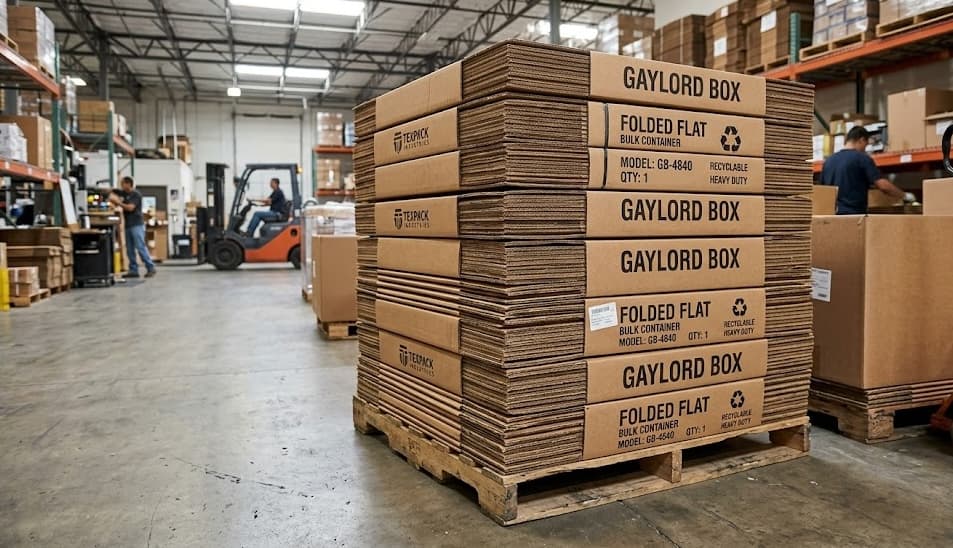
If your operation has pallets of empty gaylord boxes piling up by the dock, we’ll buy them, pick them up, and re-sell them to a company that needs bulk bins at a quarter of the price of virgin. If it’s the other way around — you need bins and don’t want to pay new-box prices — we’ll deliver grades A through C reclaimed gaylords, tested, taped and ready to load.
We’ve been doing this since 2011. It’s all we do. No chatbots, no phone trees, no 6-figure minimum orders. Read our story →
Five ways we move a box — none of them involve a landfill.
A box can be bought, sold, baled, trucked or re-cut into something else. We offer every option under one roof so our partners never have to choose between cost and conscience.
We buy your boxes
Turn your empty gaylords and bales of OCC into a revenue line instead of a dumpster line.
We sell you boxes
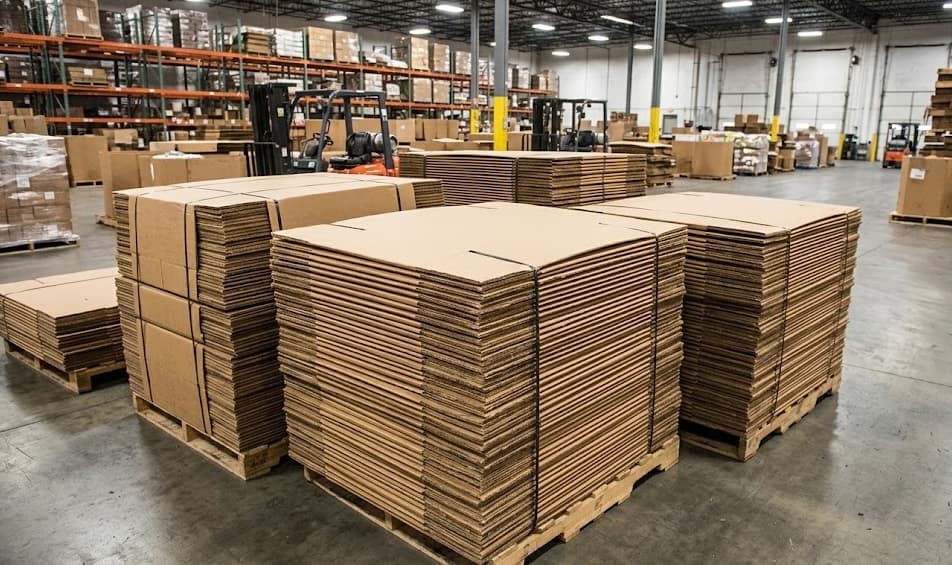
Grades A–C reclaimed gaylords, RSCs and specialty corrugated. Delivered on pallets, stacked 4-high.
Recycling & baling
On-site pickup of mixed paper, contaminated loads, dunnage and scrap corrugated — fully documented.
Freight & transportation
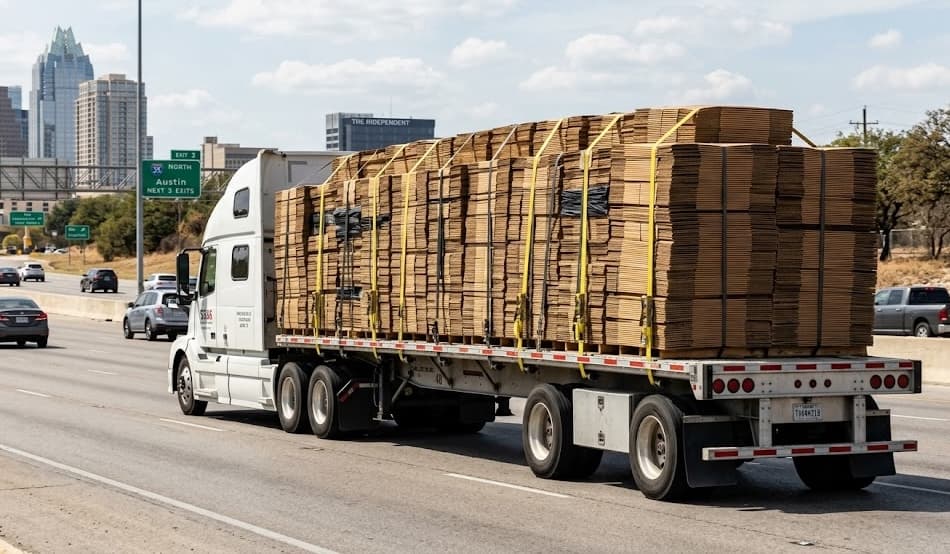
Dry van, flatbed and LTL service across Colorado, Wyoming, New Mexico, Kansas, Utah and beyond.
Custom reverse logistics
Closed-loop programs for breweries, cannabis, ag and e-com warehouses that want the same boxes back, on schedule.
Upcycled goods
Retired gaylords become planters, pop-up displays, storage cubes and prototype packaging. Weird and wonderful.
From empty dock to next dock in four moves.
Every single box we touch follows the same four-step playbook. No sorting in the dark, no vague timelines, no hidden fees.
Tell us what you’ve got
Fill out a 2-minute form. Dimensions, quantity, condition, pickup zip. We reply by email inside one business day with a buy price or a stock list.
We schedule the haul
Our dispatch team routes a dry van or flatbed — usually within 3–7 business days depending on volume — and handles the BOL and release forms.
Grade, tape, stack
At our yard every gaylord is hand-graded A, B or C, re-taped if needed, then re-palletized for its next job. Anything unfit is baled and sold as OCC.
Next life, next dock
Your box ships back out to a brewery, a cannabis cultivator, an auto parts distributor — somebody who needs a bin and doesn’t care that it has a previous zip code on it.
The honest numbers on virgin vs. reclaimed corrugated.
A brand-new doublewall gaylord carries about 23 kg of CO₂ equivalent from forest to dock. A reclaimed one, routed through our yard, adds just 1.4 kg. Multiply that over a year of pallets and the math stops being a rounding error.
Read the article| Per gaylord | New (virgin) | Used (us) |
|---|---|---|
| Avg. unit cost | $24 – $38 | $7 – $14 |
| CO₂e footprint | ~23 kg | ~1.4 kg |
| Lead time | 3 – 6 weeks | 3 – 7 days |
| Load rating | ~2,400 lbs | ~2,100 lbs |
| Trees per 1,000 units | ~44 | 0 |
What the loading docks say.
“We were paying $34 per new gaylord to move grain. DEB picked up 90 empties and turned around 200 reclaimed ones for less than half. Same spec, same handling.”
— Operations Lead, 70k bbl craft brewery“Our reverse-logistics program used to end at the recycling hauler. Now the same gaylords come back three, four times. Real circular economy, not a slide deck.”
— Sustainability Manager, outdoor-gear DTC“Grade-A gaylords in our cure rooms at a third of new-box price, plus the paperwork for our METRC audit. These people know what they’re doing.”
— Head of Cultivation, licensed producerFrequently Asked Questions
These are the questions we get on every first call. If yours isn’t here, drop it in the form and we’ll answer in writing within a business day.
See all FAQsAre used gaylord boxes really as strong as new ones?
A Grade-A reclaimed doublewall gaylord loses roughly 10% of its original stacking strength after one trip. For 90% of use cases — dry bulk storage, in-house transport, dunnage — it’s indistinguishable from new.
Do you buy contaminated or wet corrugated?
Yes. We’ll bale it, run it through our OCC stream, and document the tonnage for your sustainability report. Just tell us how many skids and we’ll quote.
How far do you drive?
Our routine lanes are Colorado, Wyoming, New Mexico, Utah, Kansas, Nebraska, Oklahoma, Arizona, South Dakota, Montana and Idaho. Anything else — we’ll partner with a freight network.
What grading do you use?
Our internal A/B/C grades map loosely to the industry standard. A = clean, once-used, intact. B = minor blemishes, 2–3 trips. C = structurally sound but visibly worked. See the full grading guide.
Is there a minimum order?
For delivered gaylords, one full pallet (48 units). For buy-backs, we typically need half a truck to make pickup pencil out, but we’ll route consolidations for smaller lots on our weekly milk runs.
Can I see the boxes before I order?
Yes — pickup at our yard is welcome with 24 hours notice. We’ll pull a sample skid for you to inspect, and you can walk through the outbound storage area to see the inventory in context. Bring close-toed shoes.
Do you ever sell through resellers or marketplaces?
No. Every transaction is direct. We don’t use distributors, marketplaces, or wholesale brokers — we sell from our yard to your yard, full stop. It keeps the math honest and the pricing tight.
What payment methods do you accept?
ACH, check, wire and credit card (small fee on cards). First orders are prepay; established accounts move to net-15 terms. We don’t do crypto and we don’t do COD.
Six sectors keep the lights on. Hundreds more pass through.
Some industries lean on us hard — cannabis cultivators and craft breweries make up almost two-thirds of our volume. But we ship and pick up across dozens of sectors every week, and the operational rhythm of each is slightly different.
Cannabis Cultivators
Cure rooms, METRC tags, drying transfers. Our biggest sector by units shipped.
Craft Breweries
Spent-grain bins, hop bag dunnage, malt supersack accessories. Our biggest sector by routes driven.
Agriculture & Produce
Pack-house bulk bins, harvest field crates, cold-chain dunnage. Seasonal flex programs.
Automotive & Foundry
Triplewall and quadwall for parts, castings, scrap consolidation. Heavy loads only.
E-commerce & DTC
Returns sortation, inbound consolidation, full closed-loop shipping programs.
Manufacturing
Bulk dunnage, line-side bins, inter-plant transfers, seasonal overflow storage.
Six standing routes. One yard. Eleven states on demand.
We run a small, dense freight network from our Denver yard. The standing routes hit the Front Range every week without fail. Long-haul lanes to New Mexico, Wyoming, Utah, Kansas and beyond run on demand.
Denver, CO
The home yard. Same-week metro pickups and deliveries.
Boulder & corridor
Tuesday and Friday milk run for Boulder, Longmont, Louisville, Lafayette.
Northern Colorado
Twice weekly to Fort Collins, Loveland, Greeley, Windsor.
Colorado Springs
Front Range south route, Mondays and Thursdays.
Pueblo
Wednesday route to Pueblo and the southern Front Range.
Cheyenne, WY
Bi-weekly Wyoming corridor route, on-demand long hauls.
How a Broadway garage became a 64,000 sq ft yard.
We have been running this business since 2011. Here is the abridged version of how we got from one pallet jack to a fleet of trucks and a baler.
2011 — The garage
1,400 sq ft on Broadway. One pallet jack, one founder, and a deal with a grain mill to take their empties away.
2013 — The first truck
A 26-foot box truck off a retiring locksmith. The first weekly milk run on the Front Range begins.
2016 — The yard
32,000 sq ft on W 2nd Ave. Eighteen dock doors, two loading pits, the first vertical baler.
2017 — Custom WMS
We build our own warehouse management system on a $2,000 budget. It still runs the floor.
2019 — Grading rubric
Our internal A/B/C grades become a written standard, stapled to every dock door.
2021 — First closed loop
A Boulder DTC brand asks for the same 40 gaylords back every week. Our first dedicated rotation.
2022 — Audited reporting
Our first independently-audited sustainability report. Fourteen findings, all addressed.
2025 — 64,000 sq ft
We expand the yard. Fourteen closed-loop programs running at scale. Same plan, bigger building.
Five things you do not get from a typical broker.
Most box brokers are middlemen with a phone line and a rolodex. We are something a little stranger: a yard, a fleet, a baler, a written grading standard, and a published sustainability methodology.
A real yard
64,000 square feet on the west side of Denver. We touch every box we sell. No drop-ship, no virtual inventory, no “sourced from a partner” quotes.
A real fleet
Trucks, drivers, dispatchers and a routing system that pairs every outbound with an inbound. Loaded both ways or it does not move.
A real grading rubric
Every box is hand-graded A, B, or C in writing before it leaves the yard. If we got it wrong, we eat the return freight.
A real audit trail
Every load is weighed, logged and reconciled monthly. Our annual sustainability report has fourteen findings worth of credibility behind it.
A real human in the inbox
Email replies inside one business day, every time, written by a person who can pull a pallet card from the WMS while you wait.
A real attitude problem
We do not bale a box that can be reused. We do not ship air. We do not hide line items. We will say no to the wrong order before we will mis-deliver it.
Used boxes, new boxes, dumpster runs — by the numbers.
Most procurement decisions about corrugated boil down to a comparison between three options: a new box, a reclaimed box, or sending the boxes you have to the landfill. Here is how those three actually stack up across every dimension that matters.
| Per gaylord, doublewall 40×48×40 | New from converter | Reclaimed from us | Landfill (no reuse) |
|---|---|---|---|
| Unit cost | $24 – $38 | $7 – $14 | $0 (but tip fee & hauler cost) |
| Lead time | 3 – 6 weeks | 3 – 7 days | Same day, sad day |
| CO₂e per unit | ~23 kg | ~1.4 kg | ~26 kg (production + tip) |
| Trees per 1,000 units | ~44 | 0 | 0 saved, but 44 wasted earlier |
| Water per unit | ~400 gallons | ~0 gallons | n/a (the water is already lost) |
| Diversion certificate | No | Yes — included in invoice | Possibly, depends on hauler |
| Closed-loop possible? | Yes, but expensive | Yes, designed for it | No |
What a year at the yard looks like.
These are the numbers we report into our annual audit. They change slightly every year, but the order of magnitude is steady.
Six articles to get you up to speed on used corrugated.
The fastest way to understand what we do — and whether it makes sense for your operation — is to read what we have already written about it. Start with these six.
Why we stopped quoting used gaylords by the pound
We tore up the per-ton spreadsheet and started quoting per unit. Here is the story.
Case studyHow we ran a closed-loop pilot with a Boulder outdoor brand
200 boxes, 13-day cycle, 89% retention rate. The pilot that became the template.
SustainabilityThe truth about “100% recycled content” claims
Why the most common eco-label on packaging is technically true and almost entirely useless.
LogisticsOne truck, loaded both ways: the only freight rule we care about
How we route every truck so it never deadheads. The 91% loaded-mile ratio explained.
OperationsInside the Denver yard: a virtual tour
A walking tour of the 64,000 sq ft yard, zone by zone, written by the yard lead.
SustainabilityHow to write a sustainability report that survives an audit
Lessons from our first independent audit. Fourteen findings. All addressable.
Your boxes have at least one more job in them. Let us help you find it.
Whether you have 50 empty gaylords by the dock or you need 500 clean ones delivered next week, the form on this page is the fastest way to start a conversation. A human will reply by email inside one business day. No phone trees. No chatbots. No AI assistants pretending to be people.
Open the quote form